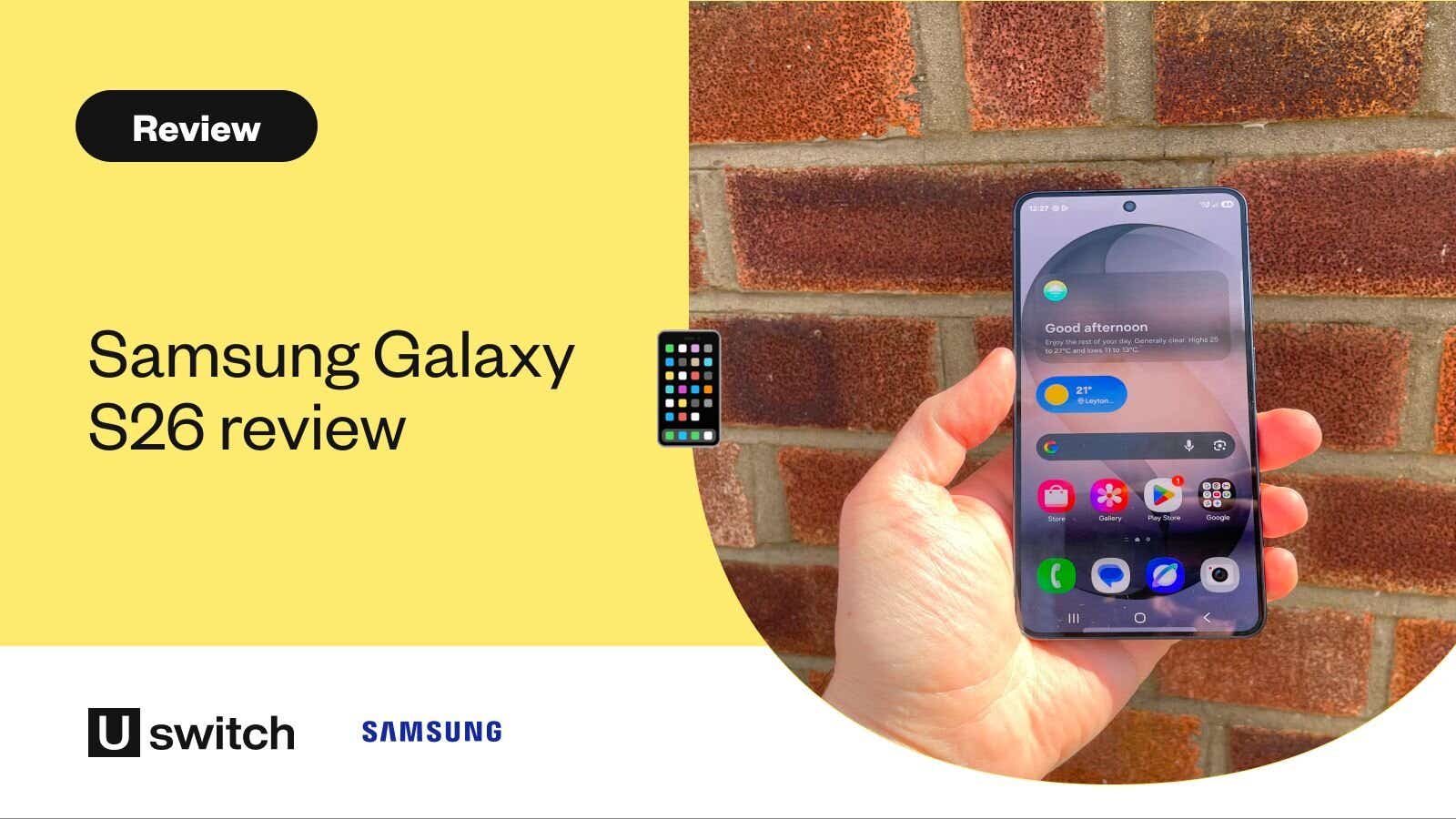
Samsung Galaxy S26 review

Samsung Galaxy S26 pros and cons
Pros
Higher entry-level storage
Longer battery life
Premium feel
Fast performance and seamless software
Plenty of AI features
Cons
Higher price
Inferior processor to US version
No privacy display like the Ultra
AI can be confusing
The Samsung Galaxy S26 is a great phone, but is that enough? It speaks volumes that even an improvement on the excellent Galaxy S25 might struggle to stand out, such is the intensely competitive nature of the smartphone market.
This year’s improvements include a higher base storage (256GB), a bigger screen and faster wireless charging. But on the downside, it comes with a higher price. Given that rival phones have pulled ahead in certain key areas, the relatively minor improvements might leave even Samsung diehards putting off upgrading for another year.
The competition isn’t only from other smartphone brands like Apple and Xiaomi, but from Samsung itself as well, with other phones in the S26 range. The S26 Plus has a bigger screen to shout about, while the S26 Ultra gets a world-first privacy display. Whereas the S26 looks a little overshadowed.
Can it step out of the shadows and into the limelight? Let’s see.
Samsung Galaxy S26 specifications
- Release Date: February 25, 2026
- OS: Android 16
- Colours: Cobalt Violet, Sky Blue, Black, White, Silver Shadow, Pink Gold
- Dimensions (HWD): 149.6 x 71.7 x 7.2mm (5.89 x 2.82 x 0.28in)
- Weight: 167g
- Screen: 6.3-inch Dynamic LTPO AMOLED
- Resolution: 2340 x 1080 (409ppi)
- Screen type: AMOLED
- Refresh rate: 1-120Hz
- Protection: Corning Gorilla Armor 2
- Peak brightness: 2,600 nits
- Battery life: 30+ hours
- Battery size: 4,300mAh with Super Fast Charging
- Waterproofing: IP68
- RAM: 12GB
- Storage: 256/512GB
- Processor: Qualcomm Snapdragon 8 Elite Gen 5 for Galaxy / Samsung Exynos 2600
- Rear cameras: 50MP main, 12MP ultrawide, 10MP telephoto
- Front camera: 12MP
- AI features: Google Gemini, Gemini Live, Gemini apps, Circle to Search, Photo Assist, Document Scanner, Now Nudge, Now Brief
- Price: £879 (256GB), £1,049 (512GB)
Samsung Galaxy S26 deals
Want to experience the Samsung Galaxy S26 for yourself? You can compare our Galaxy S26 deals now.
Design: Of a piece with its S26 siblings

Samsung has unified its design language for the S26 range – all three phones have slim bezels, curved corners and vertical camera islands on the rear. This last design touch does make the S26 wobble if placed on a flat surface, but that’s really no impediment to use.
It’s made of the same high-end materials as its pricier siblings, too. You get an aluminium frame with Corning Gorilla Glass Victus 2 protection. Add a water- and dust-resistance certification of IP68, and you’ve got a phone that’s built to withstand the elements.

Which makes its slimline, premium design all the more impressive. At 7.2mm thick, it’s just as slim as the S25 before it, and remains balanced in the hand despite segmenting all the camera workings to one top corner. The back is very resistant to fingerprints too. That’s not really relevant if you’ll be using a case, as most of us do, but still nice to know, and shows that a bit of extra thought has gone into the device.
The button layout is basic, with just a volume rocker and power button on the right-hand side – there are no camera controls or AI buttons to be found, as on more recent iPhones. But in an age where many phones are becoming overly complicated, a lot of people will appreciate this – it’s instantly familiar to anyone who’s used a phone in the last two decades.
There are six colours to choose from: Cobalt Violet, Sky Blue, Black, White, Silver Shadow and Pink Gold (the last two only being available direct from Samsung.com). They’re all quite muted, which makes the phone seem more refined and premium, though a bit more ‘pop’ would have been welcome. But again, this is largely irrelevant if you’re putting it in a case.
Display: Bright and quick to adjust

At 6.3 inches, the S26’s display has grown very slightly from the 6.2-incher of the S25. But it has the same 2340 x 1080-pixel resolution, meaning the pixel-per-inch (ppi) density does drop very slightly, though to be honest, it’s not noticeable. It also has the same peak brightness as the S25 of 2,600 nits. Sadly, it misses out on the Privacy Display of the S26 Ultra, which conceals whatever’s on-screen to the people around you.
It’s still deeply impressive. It’s so bright that it’s still easily usable even on a gloriously sunny day. The AMOLED panel also has good colour integrity and great contrast (the difference between light and dark parts of the image), so that even the murkiest areas of a video have decent dark detail.
Like other phones at this level, the screen’s refresh rate adapts between 1Hz and 120Hz. That means it can lower for static content, and crank up for faster-moving, dynamic images or fast scrolling through a social media feed. It’s quick to adjust – so much so that you don’t notice it doing so – and helps preserve battery when it’s showing still pictures.
Cameras: Still impressive, but a disappointing lack of updates

Samsung has stuck with the same camera array as on the S25: a 50MP main shooter, 12MP ultrawide and 10MP telephoto. That’s a little disappointing, especially given that this has been Samsung’s go-to array for years now. But on the plus side, the cameras are still very good.
A photo of a lake I captured lends real colour depth to the water, while the leaves in the foreground are nice and vivid. There’s plenty of light and shade on the tree trunk in the foreground too, giving it a greater sense of three dimensionality – lesser phone cameras don’t have the contrast, which tends to flatten elements like this and the overall image more generally.

A trip to the beach yielded similarly impressive results. The sun, trying to break through a clump of clouds, looks suitably dramatic, again thanks to the differences in the light and dark parts of the image. Reflections on the water below are clearly delineated, adding to the sense of realism.
A well-loved child’s swing looks appropriately drab contrasted to the shiny new chains attached to it, and the luscious green grass behind it. The zoom is very powerful too, and helps reduce blur thanks to a ‘tap to focus’ feature that steadies the camera when shooting zoomed up. A row of seafront houses are barely visible in the zoomed-out photo, but zoom in and they take up nearly the entire frame. These shots are much lower resolution though (as expected), making detail harder to pick out.


It’s not all good news. Darker sections of the image do pick up a bit of graininess, and the ultrawide camera lacks the sharpness of its higher-resolution counterpart. But the other shooting modes do still hold their own – the selfie camera brings vivid colours and spot-on skin textures, while video recording has a Super Steady Mode that allowed me to smoothly capture my son sliding along a zipline from a neighbouring zipline. The result was similar to that produced by a dedicated action cam.
It might lack the megapixel heft of the iPhone 17, but the S26 still packs some heavyweight camera skills.
The AI editing tools are also useful. These are brought under the umbrella of Photo Assist, which lets you excise unwanted elements, adjust the colours and brightness, and so on. It’s a doddle to use – you can even use natural language text prompts – and quickly delivers decent results.
Performance: Two-tier gear
We thought we had seen an end to Samsung’s two-tier approach to chipsets, but it appears not. While the S25 had Qualcomm chips across the board, the S26 reverts to Samsung’s previous strategy of giving Qualcomm processors to markets like the US and Japan, while we Europeans have to make do with Samsung’s own Exynos 2600.
Though ‘make do’ is probably a bit harsh. In use, the S26 is a powerhouse, handling whatever you throw at it – games, movies, multitasking, video editing – without breaking a sweat. That’s undoubtedly helped by the 12GB of RAM that comes as standard across both the 256GB and 512GB variants.
The 128GB model has been retired. Which makes sense, given that most people need more storage than that, but it does raise the barrier to entry: the S26 now starts at £879, £80 more than the entry-level S25 (and that was at the S25’s launch price – it’s now available even cheaper).
Given the performance, it might seem churlish to complain. But in certain metrics, the Qualcomm Snapdragon 8 Elite for Galaxy that other territories get does outperform Samsung’s chip comprehensively. It’s frustrating knowing that you’re getting an inferior experience while paying an equivalent price.
Battery: Bigger, but not much better

The S26’s battery is bigger than the S25’s, but only slightly. (Which sums up this phone really – it’s better, but only marginally.) The 4,300mAh battery does outlast the S25’s 4,000mAh unit, but it still lags behind the competition: the Google Pixel 10’s battery is 4,970mAh, while the Xiaomi 17 is a whopping 6,330mAh.
Samsung has optimised the software to run more efficiently, which does help extend the battery life. But if you’re using the S26 for anything even vaguely intensive, it will need a charge come bedtime. That probably won’t be a problem for most customers interested in the S26, but it’s worth knowing that this handset is better in this regard.
The same is true of its charging speeds. Because while the jump to 25W wireless charging is an improvement on the S25’s 15W, it still lags behind what else is available. It also won’t ’snap’ into place on a magnetic wireless charger unless you use a compatible case. That leaves it behind even the much cheaper iPhone 17e, which now has MagSafe wireless charging as standard.
Software: In it for the long haul
The Android 16 operating system comes on board, with Samsung’s OneUI 8.5 layered over the top. It will look familiar to anyone who’s used a Samsung phone in the last few years, though the move from gestures to on-screen navigation buttons (so instead of swiping back to go to the previous screen, you tap the back button in the bottom-right corner) will take some getting used to.
The AI – one of the phone’s big selling points – is a bit of a mixed bag. Now Brief (which surfaces relevant information depending on your location, calendar appointments and so on) and Now Nudge (which suggests actions based on what’s on screen) are of limited use – the former proved not much more than a glorified weather app, while the latter produced nothing I found genuinely useful.
That said, there are some useful additions, like Call Screening (an AI-powered personal assistant that asks unknown callers their reason for calling and transcribes it for you so you can decide whether to answer or not – the same feature is also found on the iPhone). And the Bixby voice assistant is also smarter than ever – tell it that the screen is hurting your eyes, and it’ll take you straight to the brightness settings, rather than just telling you how to access them.
But the AI can prove confusing. With Bixby, Google Gemini, Now Brief and Now Nudge, there’s a lot going on under a lot of different names. I can’t help but think that a simplified, more unified approach would be more straightforward.
Still, the S26 should last you. It comes with seven new iterations of Android guaranteed, alongside seven years of security updates. Anyone currently rocking a seven-year-old phone will be using the Galaxy S10, which should ram home just how long seven years is in smartphone terms.
Verdict: A nice-to-have, rather than a must-have

In some ways, Samsung has closed the gap between this and the S26 Plus and S26 Ultra. The higher starting storage and larger screen are welcome additions, but the higher price and underwhelming battery life could turn off some potential buyers.
The S26 faces some stiff competition from the Google Pixel 10 and iPhone 17. But perhaps its biggest rival is last year’s Samsung Galaxy S25. It currently sells for much less than the S26, runs the same Android software, and is rumoured to be getting the same OneUI 8.5 skin very soon. If you can do without the slightly larger screen, longer battery life and faster charging, it could be the smarter buy (especially if you pick it up refurbished).
But if you’re one of the many people who have to have the latest Samsung phone, but don’t want to spring for the bigger and pricier S26 Plus or S26 Ultra, the standard S26 will serve you well.
Boxout: Samsung Galaxy deals
Not sold on the Galaxy S26? Compare deals for other Samsung Galaxy phones
Samsung Galaxy deals
Not sold on the Galaxy S26? Compare deals for other Samsung Galaxy phones
